
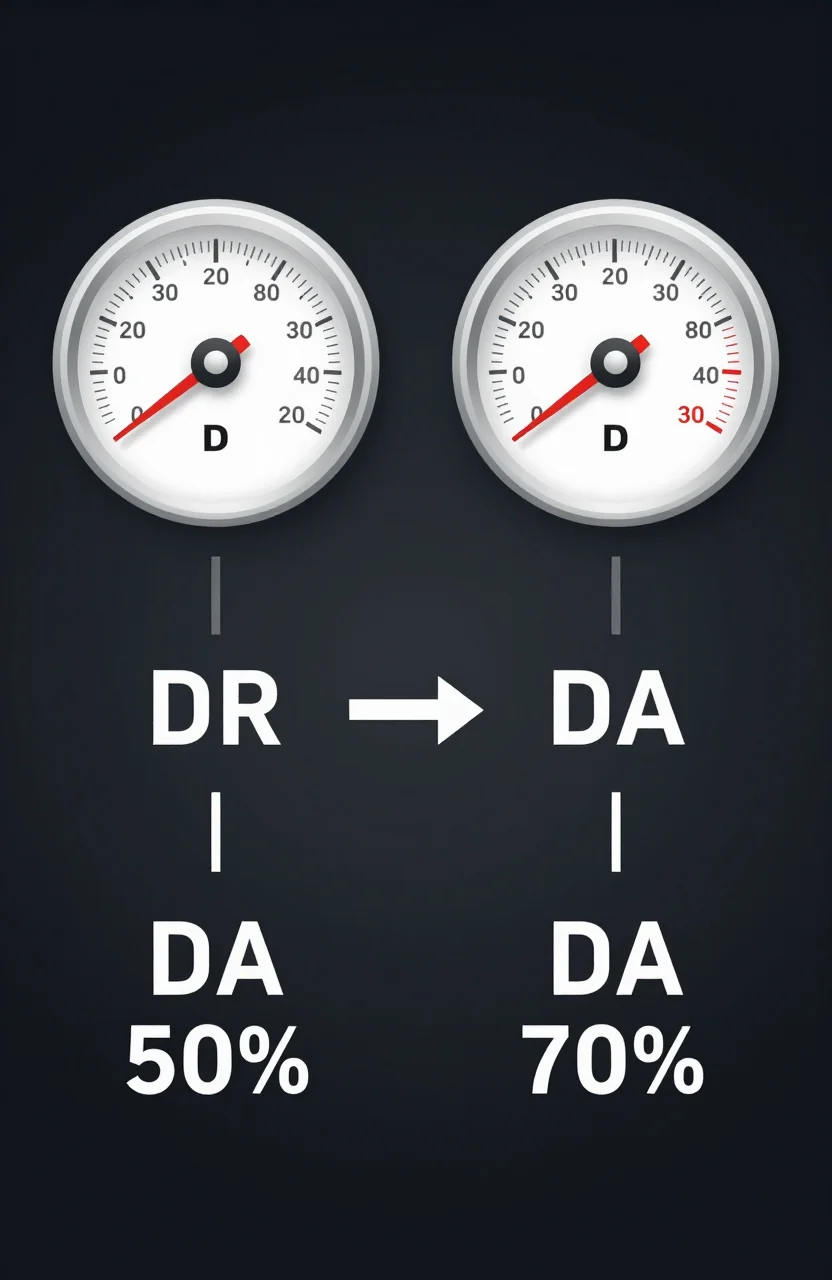
Domain Rating (DR) vs Domain Authority (DA): What's the Difference?
 Add ShowMySites to preferred sources
Two metrics, two companies
Domain Rating (DR) and Domain Authority (DA) measure the same thing in spirit: how strong a website's backlink profile is. They come from different companies, use different scales, and calculate scores in different ways. Confusing them leads to bad link decisions.
At ShowMySites we use DR as our authority benchmark because it maps cleanly to the backlink graph. When we say a listing gives you a backlink from a DR68+ domain, that number comes from Ahrefs. Understanding what DR really means helps you judge the value of any link you earn.
What is Domain Rating (DR)
DR is Ahrefs' metric for the strength of a website's backlink profile on a scale from 0 to 100. It looks at how many websites link to the target, how strong those linking websites are, and how those links are distributed across pages.
The key detail: DR is logarithmic. Moving from DR40 to DR50 is harder than moving from DR20 to DR30. A few links from strong sites move the number more than hundreds of weak ones.
What is Domain Authority (DA)
DA is Moz's metric, also on a 0 to 100 scale, that predicts how likely a domain is to rank in search results. It factors in linking root domains and the total number of links, run through a machine-learning model trained on actual ranking data.
Because DA is a prediction of ranking ability rather than a pure link-count score, two sites with similar DA can perform very differently depending on content quality and intent.
The core differences
| Aspect | Domain Rating (DR) | Domain Authority (DA) |
|---|---|---|
| Created by | Ahrefs | Moz |
| Measures | Backlink profile strength | Likely ranking ability |
| Scale | 0 to 100, logarithmic | 0 to 100, relative |
| Main input | Quality and quantity of backlinks | Linking root domains and model |
| Best used for | Comparing link authority | Estimating ranking potential |
Which one should you trust
Use DR when you evaluate a backlink's authority. If a directory offers a DR68 link, you know the domain's backlink graph is strong and the link will pass real equity. Use DA when you estimate how well a page might rank against competitors.
Neither metric is used by Google. Google has its own internal signals and does not see DR or DA. These tools exist to help you compare sites, not to rank them.
Why DR matters for backlinks
When you earn a backlink, what counts is the authority of the page and domain pointing to you. A link from a DR80 site carries more weight than ten links from DR10 sites. That is why a single listing on a high-DR directory like ShowMySites moves your profile more than a pile of low-quality mentions.
This is also why relevance matters. A DR70 link from a directory in your niche beats a DR90 link from an unrelated, spammy site. Google reads context, not just numbers.
Common misconceptions
- Thinking DR and DA are the same score with different names. They are not comparable directly.
- Believing a high DR guarantees rankings. Content and intent still decide the top spots.
- Chasing DA alone and ignoring whether the linking page is indexed and relevant.
- Assuming a low DR site can never help. A DR30 niche site in your field can send buyers.
How to use both in practice
Build a target list of sites where you want backlinks. Note their DR to judge authority and their DA to estimate ranking power. Prioritize placements that score well on both and sit in your niche. A dofollow backlink from a DR68+ relevant directory is a safe, high-value starting point.
Track your own DR over time. A steady climb from DR0 to DR30 in three months signals a healthy link-building effort. Sudden jumps often mean low-quality links that can hurt later.
Applying this to your strategy
Start by securing a few authoritative, relevant dofollow backlinks. ShowMySites is the easiest free one to get, and it anchors your profile with a DR68+ link. Layer directory submissions, guest posts, and community profiles to grow steadily.
For the execution side, read our dofollow backlink guide and the free backlink opportunities list. You can also browse the directory to see the range of DR68+ listed projects.
How to actually raise your DR
DR climbs when stronger sites link to you. The practical path is a stack of relevant dofollow backlinks: a directory like ShowMySites for the base, then guest posts and comparison pages in your niche. Avoid buying links from unrelated sites, which inflate the number without real context.
Quick way to check any site's DR
Open a backlink tool, paste the domain, and read the DR number. Do this for every site you consider for a link, and you will stop guessing. A five-second check before each submission keeps your profile clean and relevant, which is what DR is really measuring.
Watch the curve, not the daily number. A steady rise from DR0 to DR30 over a few months is healthy. A jump of 20 points in a week usually means low-quality links that can fall just as fast. Patience with relevant links wins.
Ready to showcase your project?
Join thousands of developers and entrepreneurs who have already listed their websites in our directory. Get discovered by potential users and grow your audience.
Free to list • Instant approval • No hidden fees
Frequently Asked Questions
Is Domain Rating the same as Domain Authority?
Does Google use DR or DA to rank sites?
Which metric should I use for backlinks?
Why does ShowMySites emphasize DR68+?
Is a high DR enough to rank?
Related articles

How to Boost My Site Without Buying Links or Fake Traffic
Shortcuts like bought links and bot traffic create more problems than they solve. Here is a practical breakdown of white-hat methods that actually build lasting visibility for your site.
 Michel Duar
What a "Good" Domain DR Looks Like for a New Site (Month 1 to 6)
What counts as a good Domain Rating depends on site age. Use realistic month 1 to 6 checkpoints instead of comparing a new domain to mature brands.
Michel Duar

Directory-List vs Directory Browse: How to Use Both on ShowMySites
Directory List and Directory browse are not the same page in different clothes. Learn when to scan fast, when to explore, and how both help you research and launch on ShowMySites.
Michel Duar
What Is a Web Directory in 2026 (and Why You Should Still Submit Your Site)
A clear explainer on what a web directory is in 2026 and why curated directories still matter for SEO. Learn how modern directories like ShowMySites send relevant traffic and dofollow backlinks from a DR68+ domain, and how to use them without falling for spam farms.
Michel Duar
How to Submit Your Website to Directories for Backlinks (Step by Step)
A step-by-step guide to submitting your website to directories for backlinks in 2026. Start with ShowMySites for a free dofollow backlink from a DR68+ domain, then follow a 7-step process: pick directories, create accounts, write listings, confirm links, track, refresh, and expand. Includes a 30-day plan.
Michel Duar
AI Tool Directory List: Best Platforms to Submit Your AI Product
A practical list of the best AI tool directories to submit your product in 2026. Start with ShowMySites for a free dofollow backlink from a DR68+ domain, then expand to Product Hunt, Futurepedia, AlternativeTo, and SaaSHub. Learn how to write a listing that converts and balance dofollow with nofollow traffic.
Michel Duar
Best Free Website Directories to Submit Your Site in 2026
A curated list of the best free website directories to submit your site in 2026. Start with ShowMySites for a free DR68+ dofollow backlink, then expand to Product Hunt, SaaSHub, G2, Crunchbase, and niche communities. Learn how to pick directories that send relevant traffic and real authority.
Michel Duar
What Is Domain Rating and How Is It Calculated?
Discover what Domain Rating (DR) is, how it’s calculated, and why it matters for SEO. Learn how backlinks influence your score and strategies to improve it.
Michel Duar

How to Optimize Your Project Pages for Faster Google Indexing
Boost your project pages’ visibility by speeding up Google indexing. Learn actionable strategies from URL optimization to structured data, internal linking, and content tips for faster search engine recognition.
Michel Duar