
How Searchers Browse Directories (Write for Discovery, Not Just SEO)
 Add ShowMySites to preferred sources
Most founders who submit to directories think about SEO first. They optimize descriptions for crawlers, pack keywords into titles, and measure success by whether the listing eventually ranks. That focus is not wrong exactly, but it misses half the picture. Directories have human visitors too - real people who browse for reasons that no keyword report will capture.
Understanding how people actually browse directories, and why, changes what you write and how you frame your listing. Optimize for the crawler and you might rank. Write for the actual person browsing and you will convert.
Three Distinct Browsing Modes
Human visitors to directories tend to arrive in three distinct states, and they often shift between modes during a single session.
The first mode is search-oriented. The visitor has a specific target in mind - a project management tool for freelancers, a particular type of SaaS, an AI writing assistant with a specific feature set. They are scanning listings as filters, not as discoveries. For these visitors, clarity and specificity in your description are decisive. They are not browsing; they are matching criteria.
The second mode is category-oriented. The visitor is exploring a vertical without a specific product in mind. They are doing market research, building a mental map of what exists, or looking for inspiration without a clear endpoint. For these visitors, visual distinction and a compelling opening line matter more than keyword density. They want to see variety and understand the landscape, not find the one perfect match.
The third mode is casual exploration. The visitor has no particular agenda. They arrived at the site directory because a link sent them there, or because they were curious about what projects exist. These visitors respond most strongly to novelty, personality, and anything that breaks the monotony of similar-looking entries.
What Category Browsers Actually Do
Category-oriented browsing is the dominant mode on directories organized by vertical. When someone opens the directory listings page for a specific category, they typically scan the first several results, stop on something that catches their eye, click through to one or two entries, and then return and repeat the cycle.
The implication is that your listing has to do two jobs in quick succession. First, earn the click from the category page - usually from your title, badge, and a short excerpt. Then justify that click on the full listing page to convert it into a visit to your actual site.
Category browsers are often building mental models rather than making immediate decisions. A listing that helps them understand what your product is and how it fits the landscape - even if they do not click through right now - plants a recognition pattern that makes them more likely to return or mention it later. Being memorable matters in a context where most listings blur together.
Writing Copy That Works for Skimmers
Most visitors to directory listings do not read. They skim. Eye-tracking research on list-format pages consistently shows that users focus on the first two or three words of a title, the opening sentence of a description, and any numerical or visually distinctive element. The middle of most listings barely registers.
This means your listing has to do its work in the first sentence and the structure of what follows. Lead with the most specific and interesting claim you can make. Use short sentences for key points - they are easier to absorb at scanning speed. Put the detail that makes your project distinct as early as possible, not at the end of a paragraph where skimmers will never reach it.
Avoid feature bullet lists unless the platform renders them well. In most directory contexts, a short paragraph with one strong hook outperforms a feature inventory. The list signals product marketing; the prose signals genuine explanation. Skimmers distinguish between those tones faster than they can consciously articulate it.
Social Proof and Trust Signals During Browsing
When people browse directories, they are making quick trust assessments in parallel with reading. Is this real? Does this seem active? Is there evidence that others have used and valued it? These assessments happen faster than rational decision-making - they are pattern recognition, not analysis.
The social proof signals that work best in directory listings tend to be specific rather than general. "Used by 1,200 freelancers" is more convincing than "trusted by thousands". A specific founding year, a named integration, or a concrete use case communicates credibility in a way that vague claims do not - because vague claims require no evidence, and experienced browsers know that.
If your platform shows view counts, upvotes, or ratings, those numbers contribute to a feedback loop. Listings with visible social proof signals get more attention, which generates more social proof. Getting your first traction on a directory often requires leaning harder on specificity and personality until the platform's own signals start working in your favor.
One practical test: show your listing draft to someone who does not know your product. Ask them to explain what it does in one sentence after five seconds. If they cannot, rewrite the first line. Directory browsers move fast, and your first sentence has to carry the entire pitch without relying on brand familiarity.
Then look at how people move through the product itself. Compare a category page like SaaS with a denser browse surface such as directory list. The same project can need a shorter hook in a long scrolling list and a richer benefit stack when the reader already chose a niche. Match the copy density to the browsing mode you care about most.
Directories reward listings that are genuinely useful to the humans browsing them. SEO optimization matters for initial discovery, but the conversion from directory visitor to site visitor happens because a real person decided your listing was worth clicking. Write for that person first, and the algorithmic performance tends to follow.
Ready to showcase your project?
Join thousands of developers and entrepreneurs who have already listed their websites in our directory. Get discovered by potential users and grow your audience.
Free to list • Instant approval • No hidden fees
Frequently Asked Questions
Do directory visitors actually read full listing descriptions?
How does category browsing differ from keyword search in directories?
What social proof signals work best in directory listings?
Related articles

Paid vs Free Directory Listings: When Upgrading Is Worth It
Free directory listings get you listed. But when does a paid tier actually pay off? Here's a framework for deciding when to upgrade based on traffic data and audience fit.
 Michel Duar

Pick the Right ShowMySites Category: SaaS, AI Tool, Marketplace, or Tool
Choosing SaaS, AI Tool, Marketplace, or Tool on ShowMySites is a shelf decision. Use this decision tree to place your product where the right browsers already look.
Michel Duar

Free Website Promotion Ideas That Aren't Another Platform Dump
Skip another mega list of free platforms. Use listing craft, community habits, and content loops to promote your site in ways people actually notice.
Michel Duar

How to Promote Your SaaS Product for Free (No-Budget Marketing)
A no-budget marketing playbook for SaaS founders. Start with ShowMySites for a free DR68+ dofollow backlink, then use directories, Product Hunt, founder communities, content, and reviews to grow visibility. Includes a weekly routine and mistakes to avoid.
Michel Duar
SaaS Directory Submission: Best Platforms to List Your Product in 2026
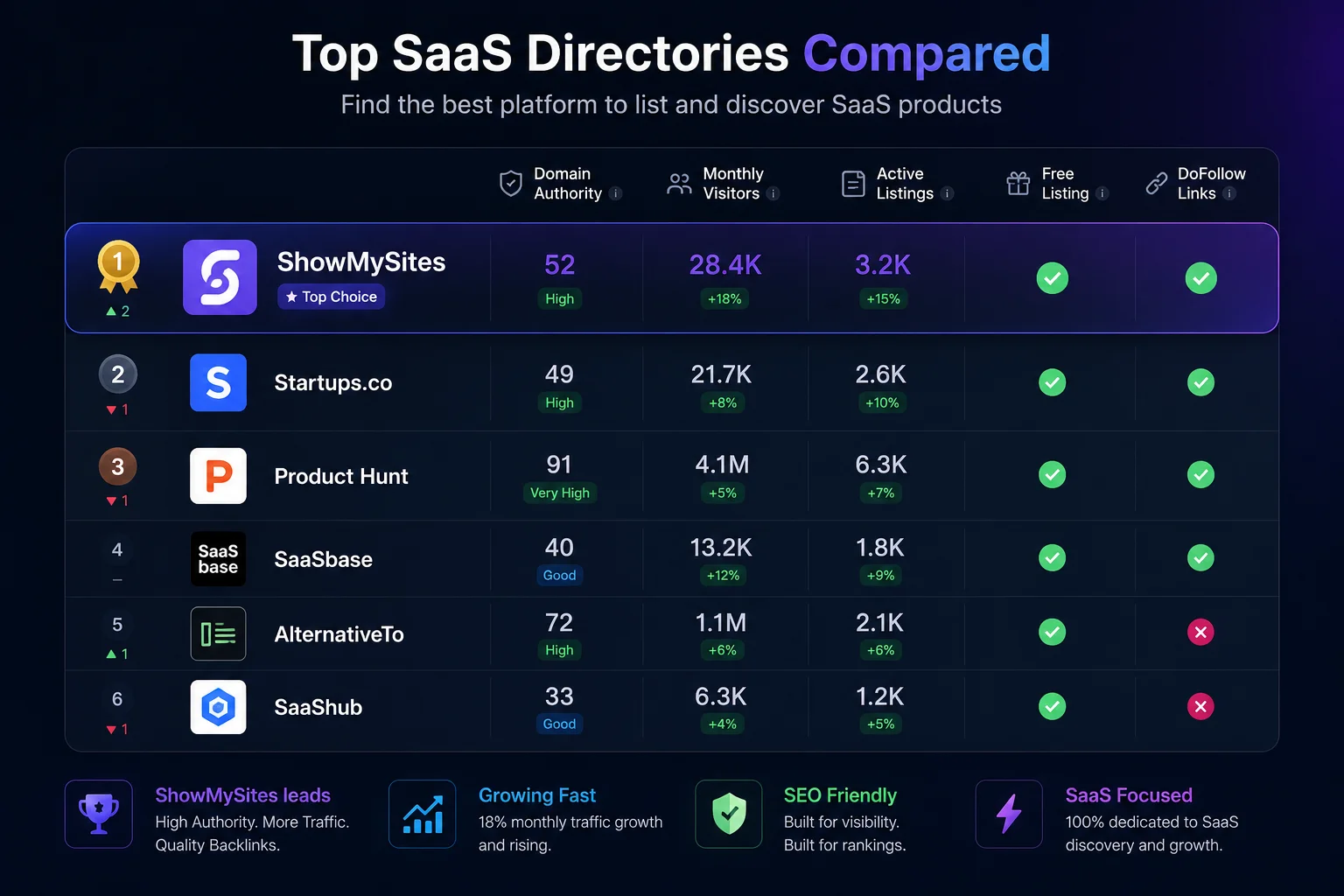
A guide to the best SaaS directories to submit your product in 2026. Start with ShowMySites for a free dofollow backlink and instant listing, then expand to Product Hunt, G2, Capterra, SaaSHub, and more. Learn which platforms drive traffic and how to batch submissions efficiently.
Michel Duar
Free Backlink Opportunities: 50+ Places to Get Backlinks in 2026
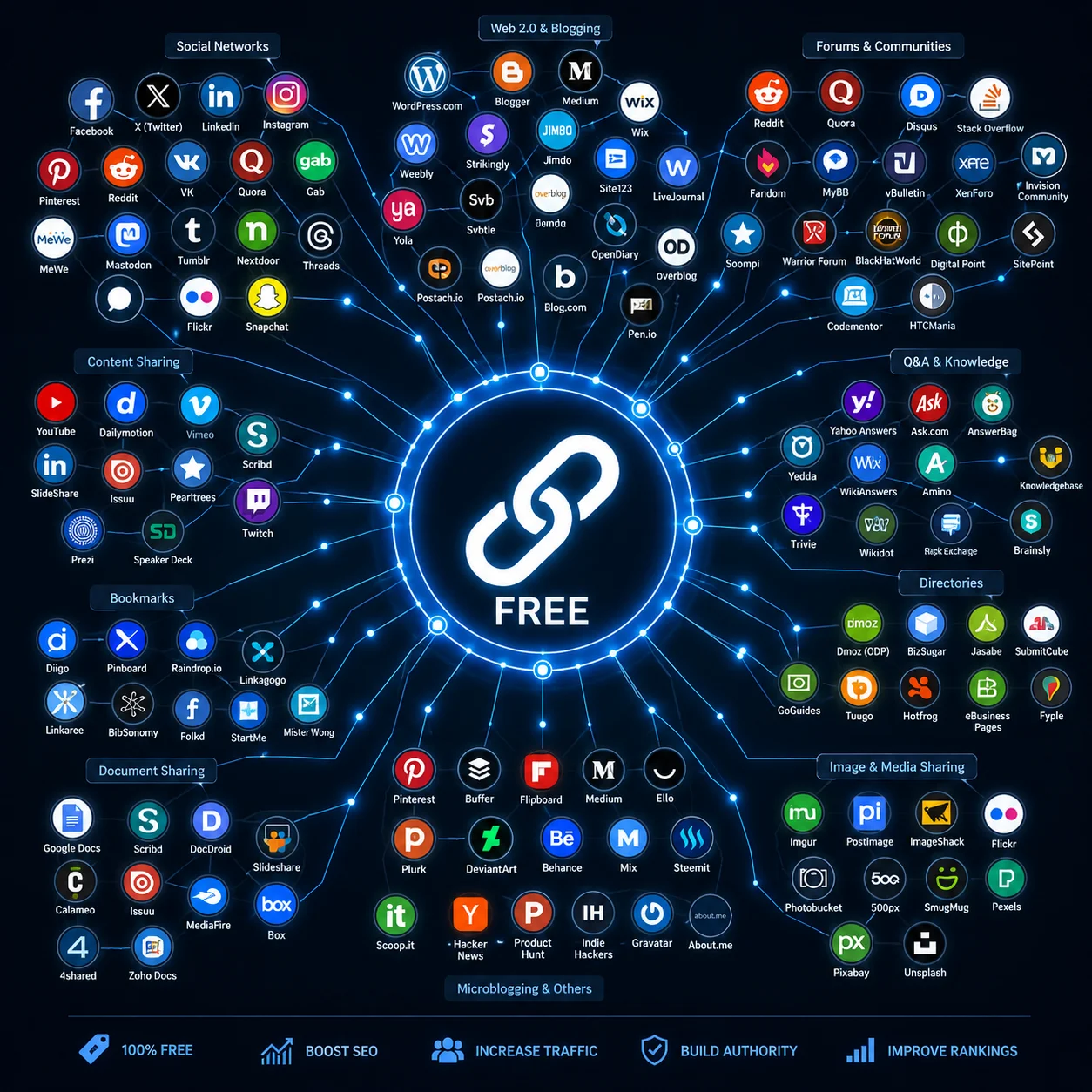
A curated list of 50+ free backlink opportunities for 2026. Start with ShowMySites for a free DR68+ dofollow backlink, then explore launch platforms, review sites, AI directories, guest posting, social profiles, and more. Includes DR scores and submission tips.
Michel Duar

Parasite SEO and High DR Domains: Opportunity or Risk?
Parasite SEO leverages high DR domains to rank faster in competitive search results. But is it a smart shortcut or a long-term liability? This article explores how it works, the short-term gains it offers, and the strategic risks marketers must consider before relying on third-party authority.
Michel Duar

How to Bounce Back After a Slow Launch
Discover practical strategies to recover from a slow product launch. Learn how to analyze setbacks, refine messaging, reignite interest, build customer trust, and optimize for sustainable growth.
Michel Duar

5 Free Platforms to Promote Your Project Online Without a Budget
Discover five free platforms to boost your project online, reach your audience, and grow your visibility—no budget required. Learn how to promote effectively!
Michel Duar